You’ve just finished a long run through Tiergarten. Or maybe you’ve pushed through a heavy session at the gym and your legs feel like concrete. The question that follows is a surprisingly common one: should I get a massage now, or wait?
It’s not as simple as „yes, go immediately.“ Massage after exercise can be genuinely useful for recovery — but the timing matters more than most people realise, and the type of massage matters even more. Get it right and you may feel noticeably better in the days that follow. Get it wrong and you might end up more uncomfortable than when you started.
Here’s what you actually need to know.
Does Massage After Exercise Actually Help?
Short answer: research suggests it can, yes — though it’s not a miracle fix.
A frequently cited 2012 study published in Science Translational Medicine found that massage after intense exercise appeared to reduce inflammation at the cellular level and may support mitochondrial development in muscle tissue. More practically, a number of studies have found that post-exercise massage can help reduce delayed onset muscle soreness (DOMS) — that deep ache that tends to peak around 24 to 72 hours after a tough workout.
Many athletes and regular gym-goers also report that massage helps them feel less stiff, sleep better, and return to training sooner. That’s not just anecdote — there’s a reasonable body of evidence suggesting massage may support parasympathetic nervous system activity, which is the „rest and digest“ mode your body needs to actually recover.
What massage won’t do is speed up muscle repair in some dramatic, superhuman way. It’s a support tool. A good one, used well.
The Timing Question: When Should You Book?
This is where most people get confused — and where a lot of well-meaning advice goes wrong.
Immediately After Exercise: Usually Not Ideal
If you’ve just finished a race, a hard interval session, or a heavy lifting day, your muscles are acutely stressed. There may be micro-tears in the muscle fibres (that’s normal — it’s part of how muscles adapt and grow stronger). Applying deep pressure to already-inflamed tissue right away can sometimes increase discomfort rather than reduce it.
There’s also a practical consideration: your heart rate is elevated, your body temperature is high, and your circulation is already working hard. Deep tissue work on top of that isn’t always comfortable or useful.
That said, lighter techniques — gentle effleurage, passive stretching, or a relaxation-focused Swedish massage — can feel good immediately post-exercise and may help ease the transition from high exertion to rest. It’s the intensity of the massage that needs calibrating, not necessarily the timing.
The 24–48 Hour Window: Often the Sweet Spot
For most people doing moderate to intense training, booking a sports massage somewhere between 24 and 48 hours after exercise tends to work well. By this point, the acute inflammation has started to settle, but DOMS may be setting in — and that’s exactly when targeted massage work can be most useful.
If you’re a runner training for a Berlin race (the Marathon, a half, or just consistent weekly mileage), building a post-long-run massage into your schedule the following day is a sensible habit. Many of the runners we work with do exactly this — a longer run on Sunday, a recovery massage on Monday afternoon, back to easy running by Tuesday.
Before a Big Event: Tread Carefully
This one surprises people. Getting a deep tissue massage the day before a race or a major competition is generally not recommended. Deep work can temporarily reduce muscle activation and leave you feeling heavy or sluggish. If you want massage before an event, keep it light — a gentle Swedish session two to three days out is usually fine for most people.
Types of Massage for Post-Workout Recovery
Not all massage is the same, and choosing the right type matters.
Sports Massage
This is the most targeted option for athletes and active people. Sports massage combines techniques from Swedish and deep tissue work, often with a focus on specific muscle groups that are under load from your training. A good sports massage therapist will ask about your training, your areas of tension, and what you’re preparing for — and adjust accordingly.
It’s not always the most relaxing experience. Expect some discomfort, especially in areas that are tight or overworked. That said, it shouldn’t be genuinely painful. If it is, say so.
Deep Tissue Massage
Deep tissue work focuses on the deeper layers of muscle and connective tissue. It’s useful for chronic tension, knots, and areas of restriction that have built up over time. For someone who runs regularly and carries tension in their calves, IT band area, or lower back, deep tissue can be very effective — but again, timing matters. Don’t book this for the day of or the day immediately after a very hard session.
Swedish Massage
Often underestimated by sporty types who assume they need something „stronger.“ Swedish massage uses long, flowing strokes and moderate pressure. It’s excellent for circulation, for calming the nervous system, and for the kind of full-body reset that helps you actually sleep and recover. If you’ve had a tough training week and you’re exhausted rather than specifically sore, a relaxation massage may serve you better than deep tissue.
Hot Stone Massage
Less commonly associated with sports recovery, but the heat element can help ease muscle tension and promote relaxation. Some clients find it particularly useful in winter months or when general fatigue and tightness are the main issue rather than specific sports injuries.
Practical Advice: Making the Most of a Post-Workout Massage
A few things worth knowing before you book:
Hydrate properly beforehand. Well-hydrated muscles respond better to massage. Aim to drink enough water in the hours before your session — not just immediately before.
Be honest with your therapist. Tell them what you’ve been doing, when you last trained, and where you’re feeling it. A therapist who knows you ran 25km two days ago will approach your session differently than one who doesn’t. This is especially important if you’re booking a mobile massage — your therapist will ask during the consultation at the start of the session.
Don’t train hard immediately after. Give yourself a few hours at least. Your muscles have just been worked on; they need time to settle. Light movement — a walk, some gentle stretching — is fine. A heavy session is not.
Expect some post-massage soreness. Particularly after deep tissue or sports massage. This is normal and usually passes within 24 hours. It’s not a sign something went wrong.
Consistency matters more than one session. A single massage can feel great. Regular massage — even once or twice a month — tends to produce more meaningful results for people in consistent training. Think of it as part of your recovery toolkit, not a one-off treat.
Why Mobile Massage Works Particularly Well for Recovery
Here’s something practical: after a hard training session, the last thing most people want to do is travel across Berlin to a studio, find parking, change in a shared changing room, and then commute home again.
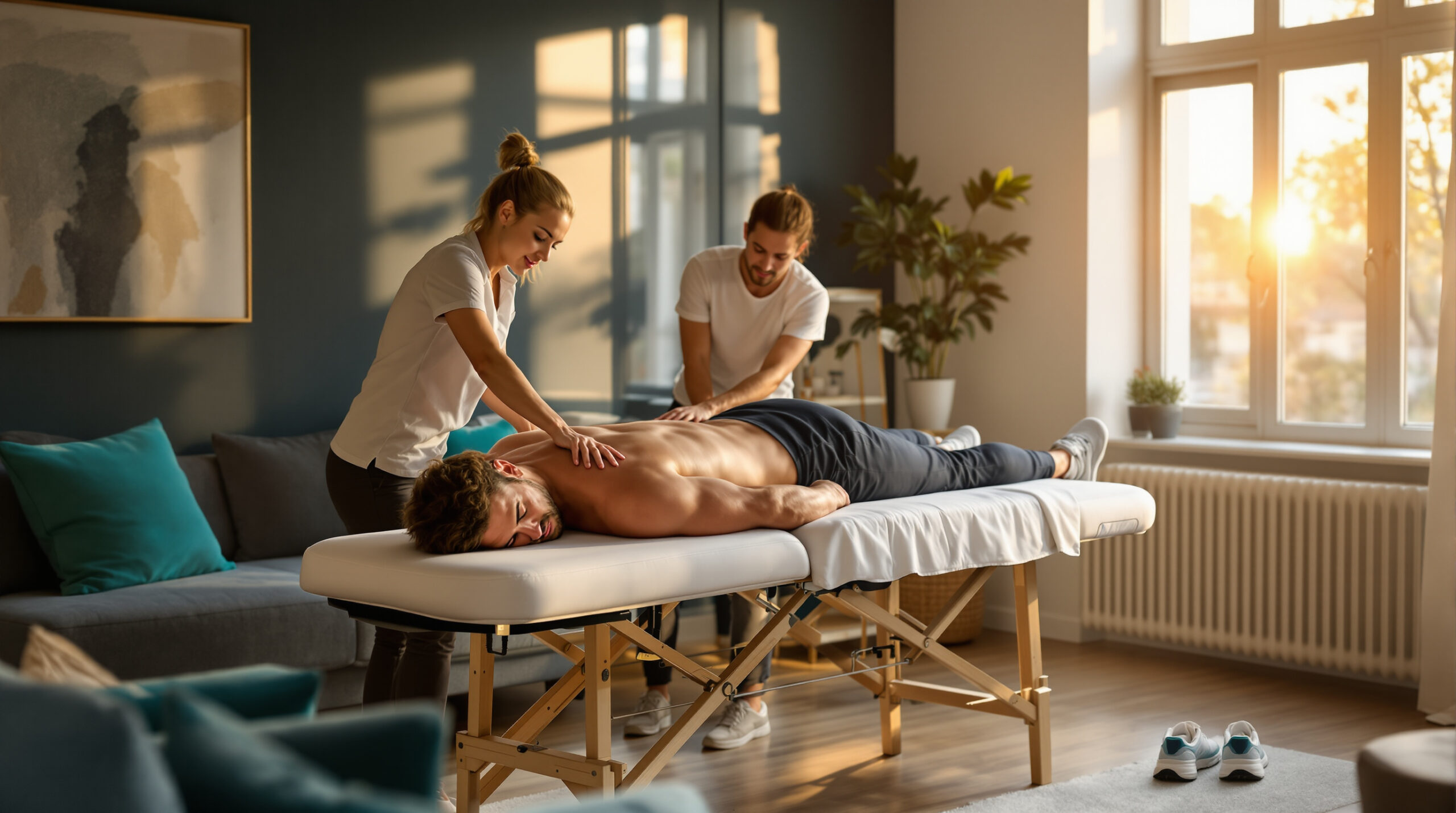
With mobile massage, none of that applies. Your therapist comes to you — whether that’s your flat in Prenzlauer Berg, your hotel near Alexanderplatz, or your office in Mitte. We bring the professional table, fresh linens, and everything else. You don’t move until you’re ready.
For recovery, this is genuinely useful. You can go from massage straight to your sofa, your shower, or your bed. No adrenaline spike from navigating public transport. No energy expenditure you didn’t plan for. Just rest.
That’s not a small thing when your body is trying to recover.
Ready to Book Your Post-Workout Massage in Berlin?
Whether you’re training for the Berlin Marathon, managing a heavy gym schedule, or just trying to stay on top of the aches that come with an active life — we can help.
Our therapists are qualified, insured, and experienced in sports and deep tissue work. We cover all Berlin neighbourhoods, seven days a week, and we bring everything with us. Booking takes about three minutes online.
Your legs have done the hard work. Let us handle the recovery.
[Book your session →]
—
Disclaimer: This article is intended for educational purposes only and does not constitute medical advice. The information provided reflects general wellness guidance and should not be used to diagnose, treat, or manage any health condition. If you have concerns about an injury, chronic pain, or any medical issue, please consult a qualified healthcare provider before booking a massage.